Pro Tools 9: The Mixer’s Toolkit
With Kevin Ward. Focal Press, 19 April 2011. Taking a demo recorded in a garage and turning it into a radio-ready rock mix, one chapter at a time. Publisher's page.
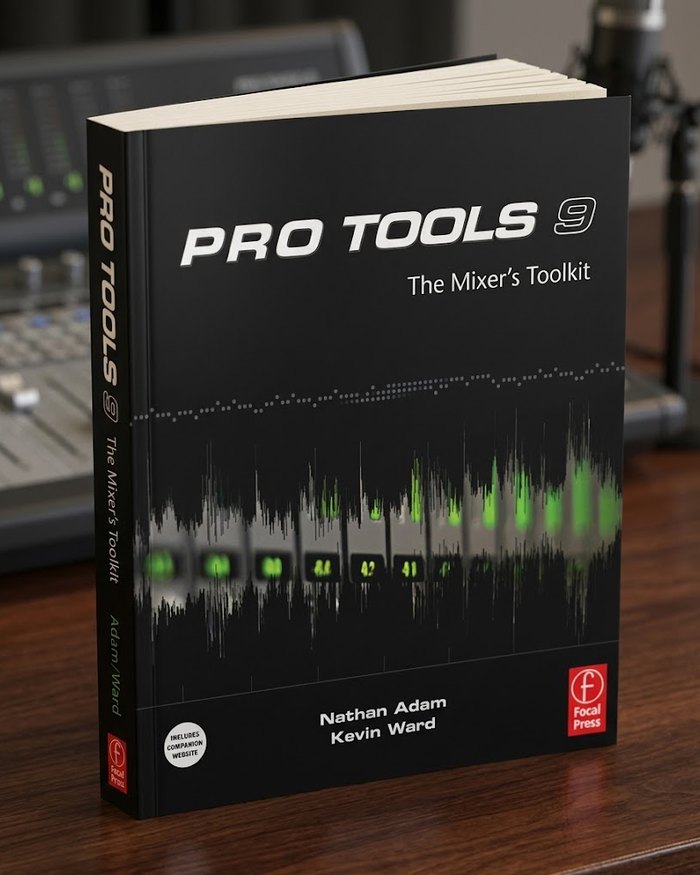
The second one
The first book was about repairing and assembling performances. Editing, pocketing, pitch. This one picks up the second the parts are all there and none of them are wrong any more, which is the moment a lot of people discover they have no idea what to do next. Mixing. Turning a pile of correct tracks into a record somebody would actually choose to put on.
We wrote it for Pro Tools 9, which dates it exactly, and I've decided to be happy about that. Version 9 was the release that finally cut Pro Tools loose from Avid’s own hardware. You could run it on an ordinary interface for the first time, so overnight the audience for a mixing book stopped being people who owned a studio and started being anybody with a laptop. That's the whole reason this book has the shape it has.
What’s in it
One session, followed the whole way through. Two hundred and sixty pages, twelve chapters: session overview and setup, drum editing, bass guitar, guitar mixing, bus mixing, drum mixing, vocal mixing, timing fixes, premastering, the final mix, and a closing chapter on Pro Tools systems themselves.
The techniques in it are the ones people actually use, not the ones that demo well at a trade show. Buss mixing and parallel compression. Micro-editing, Elastic Time and Beat Detective across drums, bass, guitars and vocals. Delay tricks and vocal automation. Multi-compression, reverbs and delays for the eternal problem of getting a part to sit forward without just… turning it up. Then premastering, so the thing holds its own against whatever the radio plays after it.
The premise is deliberately unglamorous, and I'd defend that choice all day. Start with a demo somebody tracked in a garage. End with something that survives being played on the radio. Not a hit record with a hundred thousand dollars of studio time in it. The tracks most people actually have sitting on a drive.
The DVD became a website
The first book shipped with a DVD carrying a real Nashville session to work along with. This one did the same thing, except the session and the video tutorials sat on a companion website instead of on a disc.
At the time that was a production footnote. Nobody in the room thought it was interesting. Looking back, it was the whole direction of travel, and we walked into it without noticing. Five years between the two books, and the material went from a plastic disc in a sleeve to something you loaded in a browser. Then it kept going. The LANDR course is the same instinct two formats further down the road, with no object in your hands at all.
There is a joke in here at my own expense. The website is long gone. The DVD in the back of the first book, the format I was quietly pleased to be moving on from, is still sitting in every copy that was ever sold. Whatever you can say about a disc, nobody can switch it off.
I'd like to claim I saw that coming. I didn't. :) I just wanted the reader to be able to open the session without hunting for a drive that could still read a DVD.
Kevin Ward
Kevin has been behind the board since 1991, for Dolly Parton, Vince Gill, Judy Collins and the Prague Philharmonic Orchestra, with a long body of work in Christian music besides. He founded Vine Records and mixcoach.com.
Which is the same pattern as the first book, where Brady Barnett was the editor and I was the guy who noticed nobody had written any of it down. That is more or less my entire method, and I'm fine with it being obvious. Find somebody working at a level most people never get to stand next to, then build the thing that lets them be stood next to.
It went out of print and got more expensive
Focal Press stopped printing it. That normally ends the story, and for the first book it did. You can buy that one used for about three dollars.
This one did the opposite. Seven used sellers on Amazon when I checked in September 2026 and not one of them under forty-eight dollars, with a note on the listing saying one copy left. Fifteen years after publication, for a book about Pro Tools 9.
I want to be careful here, because this is exactly the kind of thing an author talks himself into meaning something. It probably means a smaller print run. Scarcity is a duller explanation than merit and it is usually the right one. But I will admit I did not expect the shorter, newer book to be the one that held its value, and I would not have bet that way.
Related
Multi-Platinum Pro Tools (2006) came first. The LANDR course is the same material in the format that replaced books.
Wondering which half of your own work is at risk?
Ten questions about how you actually get paid, and my honest read on what's exposed and what isn't. No score, because a score would be a number I made up.